
When we talk about solar energy in agriculture, the conversation almost always stops at one point: savings on the electricity bill. But that's only part of the story—and perhaps not the most important. Brazilian agribusiness still relies heavily on fossil fuels to operate, and this dependence comes with a cost beyond the price at the pump: exposure to market shocks that the property does not control.
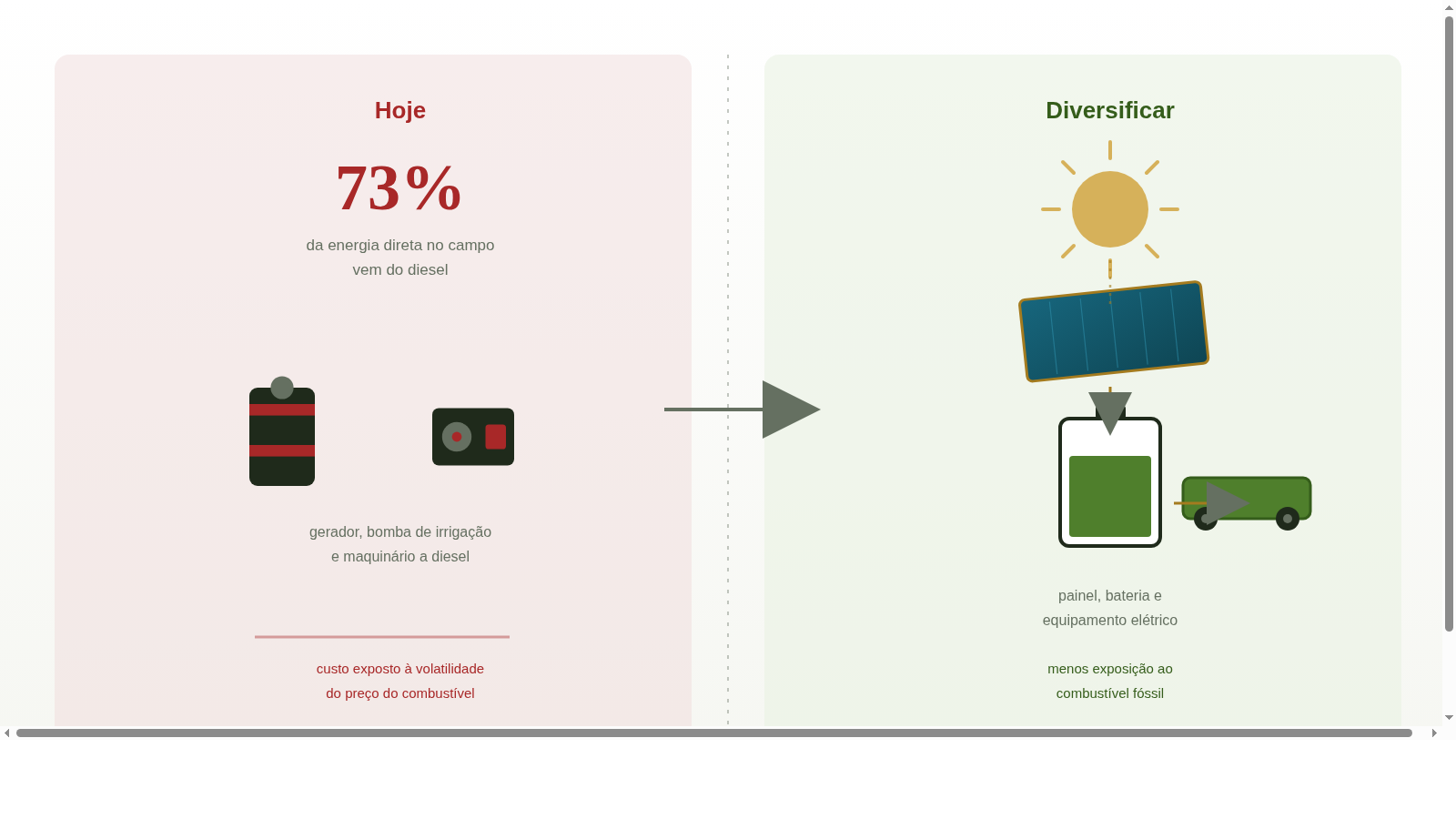
The problem is not only the diesel price
The Brazilian agricultural sector accounts for 73% of direct energy consumed in the field coming from diesel — above-average share globally, 70%, according to a survey about energy supply and demand dynamics in agribusiness. Machines, grain transport trucks, irrigation pumps and generators depend directly on this fuel to operate — and the EPE projects demand of 72 billion liters of diesel in 2026 just to cope with the strength of agriculture, logistics, and the national industry.
This dependence has a concrete price: the Campo Futuro Project (CNA and Senar) shows that the Diesel price increases have already impacted Brazilian agribusiness by R$7.2 billion, potentially exceeding R$14 billion case the scenario persists. In regions like Cerrado, Matopiba, and the Northeast interior — where fuel logistics infrastructure is more limited — exposure is even greater.
The real growth of solar energy in the field
Meanwhile, solar energy continues to grow consistently in Brazil. The ANEEL projects 9.1 GW growth in the Brazilian electricity mix by 2026, with solar generation accounting for nearly half of this expansion. Photovoltaic energy is already present in at least 7.3 million Brazilian households, according to ABSOLAR — including a growing share of rural properties that install panels to reduce dependence on the grid and on fuel.
This is not speculative betting: it is a trend already underway, with real numbers behind it.
Diversify the property's energy mix
Most discussions about solar energy in agriculture still treat the panel as something that sits on the headquarters roof, powering the house and office—not the operation itself. But the same principle can extend to what runs beyond the gate: electric equipment powered by solar energy, substituting part of what today depends on diesel for repetitive daily tasks.
This is an important scope difference. Diversifying the property's energy matrix is not only about "spending less" — it means relying less on a single input whose price is not controlled by the property, and whose supply logistics can fail precisely when it is most needed.
Where the Caatinga Rover fits
That's the space where the Caatinga Rover positions itself: a 4x4 electric platform, solar-supported, designed for repetitive field tasks — such as row-to-row mowing and localized spraying — which today, on most properties, still depend on combustion machines. We detail the Rover's battery and solar panel architecture in Battery and Solar Energy: How Caatinga Rover Stays Operational in the Field.
The same reasoning already appears in another real context: solar power plants also require vegetation management between their panel rows — a task we discussed in Vegetation Management in Solar Plants. It is solar energy taking care of the solar energy infrastructure itself.
Institutional situation
Caatinga Rover is in TRL 5 — validation in a relevant environment, not a ready-made commercial product. The Rover's real energy autonomy figures are still evolving across prototypes, and we publish this evolution transparently, without promising a result not yet achieved. The point here is not that the Rover will replace the entire diesel fleet of a property — it represents a concrete path toward diversification for specific, repetitive tasks that today depend on fuel.
Learn more: Customers and Partners · How to test the Caatinga Rover