
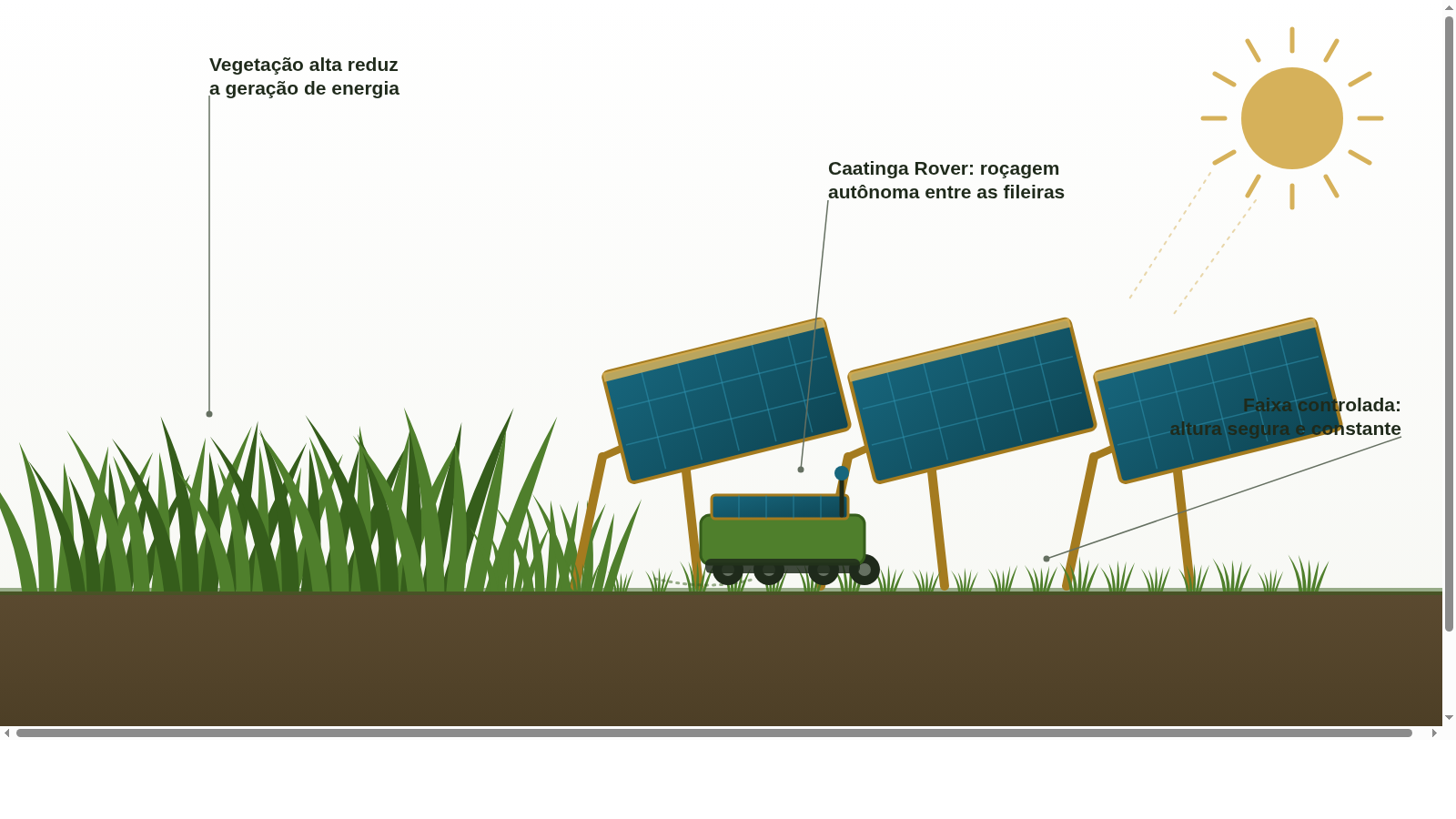
Photovoltaic solar plants face an operational issue rarely discussed outside the sector: the vegetation that grows between and under panel rows needs constant management. Tall vegetation reduces generation efficiency due to shading, increases fire risk, and complicates maintenance—and cutting is currently mostly manual or with conventional mowers, during long shifts under direct sun.
Why this is a relevant market for agricultural robotics
Brazil has been rapidly expanding its installed solar photovoltaic capacity, and each plant—small or large—requires periodic vegetation management throughout the installation's lifetime, typically 20 to 25 years. It is a repetitive, predictable task performed on relatively regular terrain (compared to open fields), making it a technically more tractable application for agricultural automation than irregular crops.
Pilot in progress
A Interconnect, an operation and maintenance (O&M) company for solar photovoltaic plants headquartered in Fortaleza (CE) and operating in plants of different sizes in Ceará and Pernambuco, participates in a field pilot operation with Caatinga Rover, focusing on inter-row mowing and around the structure. More details about this pilot and other technical partners are in Customers and Partners.
What this application requires from the equipment
- Accurate navigation between rows, with safeguards intended to reduce collision risk around structures and wiring.
- Adequate traction on soil with variable cover crop, treated in Autonomous 4x4 traction.
- Energy-autonomy compatible with scheduled maintenance shifts, supported by the solar system described in Battery and Solar Power.
Institutional situation
This pilot is a field validation operation — it does not represent a formal commercial partnership, exclusivity, or commercial availability of the Caatinga Rover for the solar O&M sector, which remains at TRL 5.
Learn more: Customers and Partners · How to test the Caatinga Rover