
Stage note: energy figures and control behaviours described below are design references to be verified in documented field tests, not certified current performance.
One of the most frequent questions about Caatinga Rover is direct: how long does it work without stopping? The honest answer is not simple — it depends on the terrain, payload, operating time, and the condition of the solar panel. But it is precisely this complexity that makes the project’s energy system one of its most relevant technical differentiators.
This article is part of the series How the Caatinga Rover works. Also read about the autonomous 4x4 traction system.
The Autonomy Dilemma: More Battery, More Weight
Laboratory robots run on mains power. Agricultural robots must carry all their energy for hours. This creates a classic embedded engineering dilemma: more battery means more autonomy, but also more weight— which increases motor consumption, which demands more battery. A cycle that must be broken with efficiency.
Caatinga Rover tackles this problem from two sides simultaneously:
- Reducing consumption: high-efficiency DC motors, terrain-adaptive speed control, low-power mode when in static monitoring
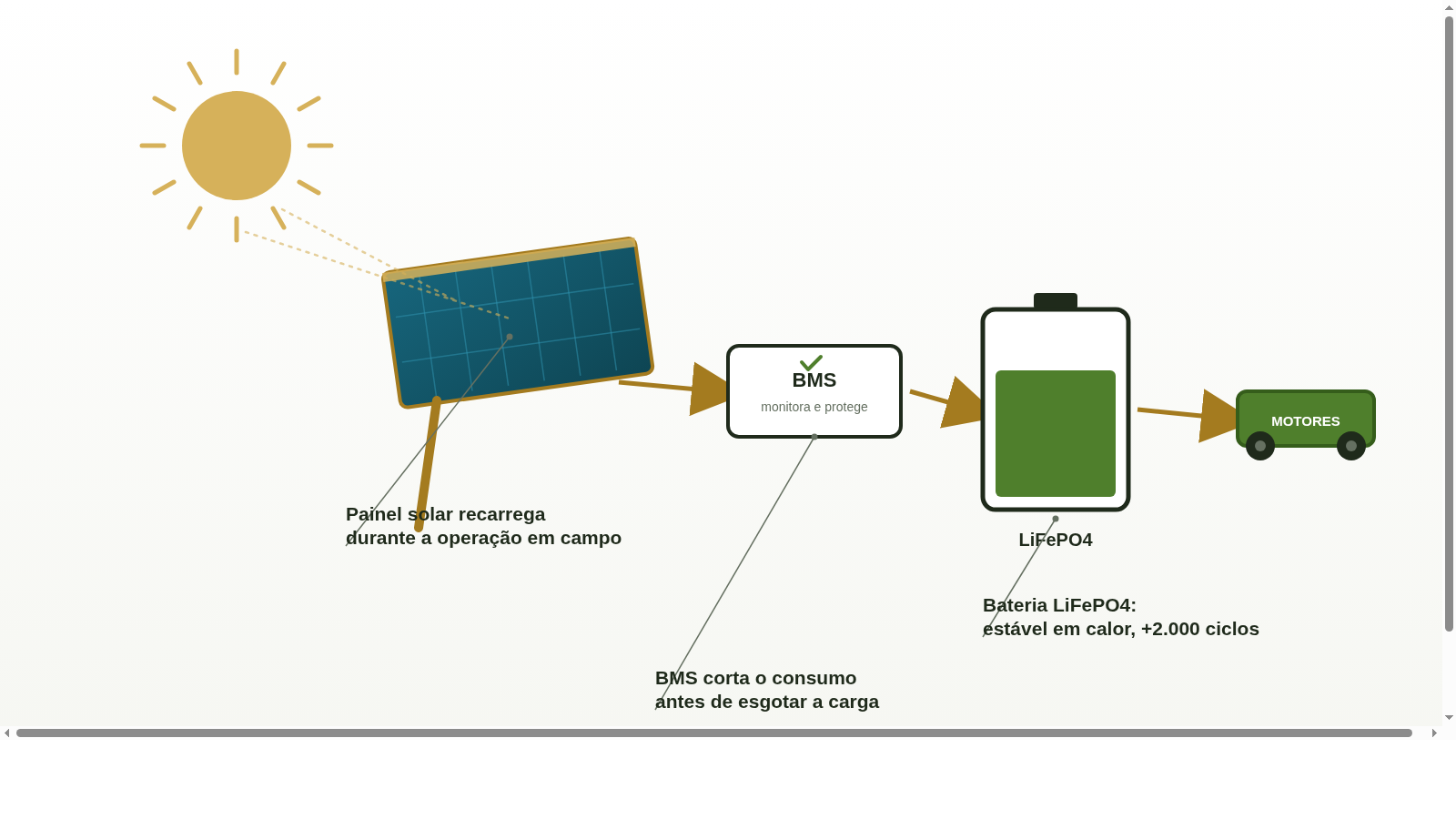
- Generating energy during operation: integrated photovoltaic solar panel that recharges the batteries while the robot works in open field
Why LiFePO4?
The Caatinga Rover battery system is based on LiFePO4 cells (Lithium Iron Phosphate), chosen over conventional Li-ion for practical field reasons:
- Superior thermal stability: does not undergo thermal collapse in the hot temperatures of the Brazilian semi-arid
- Partial charge cycles: accepts intermittent recharge (like solar) without accelerated degradation
- Long service life: more than 2,000 complete cycles — in partial cycles, the life is significantly longer
- Safety in outdoor environments: does not release toxic gases in case of mechanical damage
The Role of the Solar Panel: It is not just a complement
The solar panel integrated with Caatinga Rover is not a decorative element or a minor add-on — it is a central part of the project’s value proposition. In the Caatinga biome, with 5.5 to 6.5 hours of peak sun per day, an 80–150W panel can supply between 400 and 900 Wh/day of net energy.
In light monitoring missions (low speed, sensors always on, camera active), the Caatinga Rover design objective is to achieve energy balance neutral: the robot returns at the end of the day with a charge level similar to the start of the mission. We haven't reached that yet — but progress across prototypes shows it is possible.
"A robot that goes to the field and returns with more energy than it left with is the goal. Caatinga receives abundant sun — we just need to use it efficiently."
Smart Energy Management (BMS)
One Battery Management System (BMS) monitors and protects the cell package in real time:
- State of Charge (SoC) of each individual cell
- Operating temperature and overheating alert
- Ingress current (solar panel) and output (motors and electronics)
- Dynamic estimate of remaining range
When the SoC falls below a configurable threshold, the BMS triggers the power-saving mode: automatic slow speed, non-essential sensors turned off, and a supervised energy-safety procedure; automatic return-to-base remains a development target.
Real Autonomy vs. Specification Autonomy
Manufacturers frequently publish autonomy under ideal conditions. In the real field, the factors that most reduce Caatinga Rover's operational autonomy are:
- Sloped terrain: long climbs can triple consumption relative to the plan
- Tall vegetation: partially blocks the solar panel and reduces recharge
- High ambient temperature: affects both the efficiency of the photovoltaic cells and the battery capacity
- Attached implements: sprayers, sample collectors — each additional kilogram directly impacts
Publishing real — not optimistic — autonomy is part of our commitment to technical transparency with future Caatinga Rover users.
In the next article, we dive into the most fascinating part of the system: how the Caatinga Rover makes decisions on its own using embedded Artificial Intelligence — not cloud dependent.