Modular agricultural implements for the Caatinga Rover
A robotic base powered by electricity designed to accept different tools according to the task. The mower implement and sprayer are under validation; the other modules proceed as development fronts.
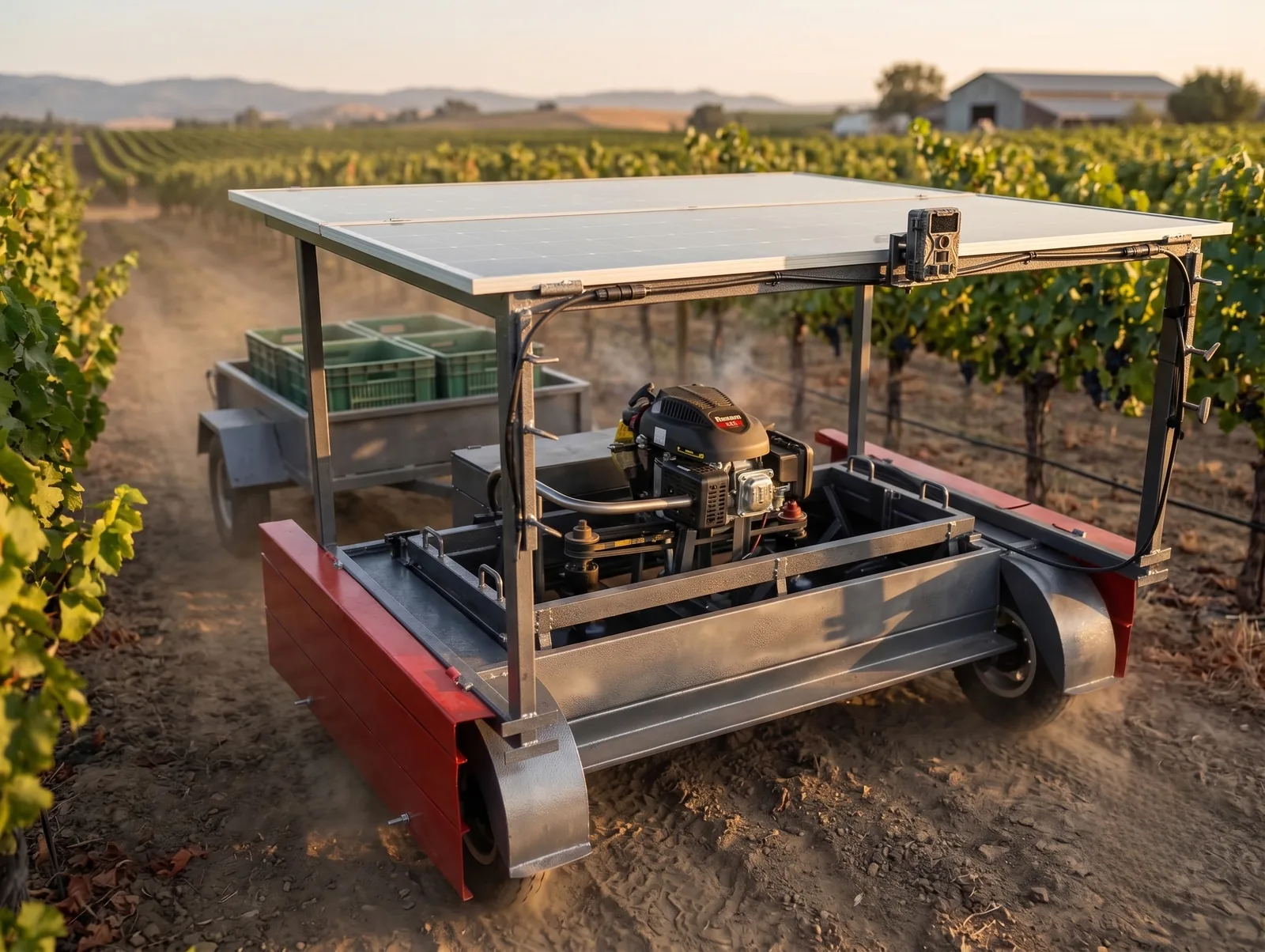
Attached mower Visual reference · configuration in validation
Technical detailImage in preparation
Field trialImage in preparation
▶Implementing device videoIn preparation
Prototype under validation
Mower implement for inter-row management
Designed to support vegetation management in repetitive tasks, with width compatible with different cultivation contexts and adjustable cutting height.
Cutting width
1,25 mcurrent configuration
Cutting height
Adjustabledefinition range
Planned application
Between linesvegetation management
What will be measured in tests
Uniformity and cutting quality
Energy consumption and vibration
Projection of debris and protections
Durability under real field conditions
Image in preparationSprayer attached 16:9 · main photo
Injector arrangementImage in preparation
Guided applicationImage in preparation
▶Implementing device videoIn preparation
Prototype under validation
Sprayer for espalier and trellis
Designed for targeted application in crops trained on trellises, with a frame adaptable to plant positioning. The hydraulic configuration will be defined from agronomic trials.
Drive systems
Back support and trellisproject application
Tank capacity
Under definitionTechnical sizing
Hydraulic system
In validationpressure, flow and nozzles
What will be measured in tests
Coverage and uniformity of application
Flow, pressure and nozzle selection
Operator drift and exposure
System stability and safety
Next modules
Implements in development
The features below are project requirements and goals based on market practices. They do not represent completed specifications.
In development
Transport platform
Support internal transport of tools, inputs, and small loads within the property.
Design requirements
Stability, anchorage points, balanced load distribution, and operation on uneven terrain.
Still in definition
Payload capacity, useful dimensions, and tilt limits
Required trials
Static and dynamic load, braking, stability, and structural durability.
In development
Quick-coupling interface
Standardize the mechanical and electrical connection between the robotic base and different modules.
Design requirements
Simple swap, secure locking, module identification, and connection protection.
Still in definition
Final geometry, available feed and identification protocol
Required trials
Repeatability of the fit, vibration, dust, moisture, and replacement cycles
In development
Sensing and mapping
Georeferenced recording of traveled areas and support for agronomic research.
Design requirements
Camera, RTK/IMU positioning, data logging, and potential for agronomic sensors.
Still in definition
Hardware, accuracy, agronomic indicators, and report formats
Required trials
Positioning accuracy, data quality, repeatability, and field operation.
In development
Robotic arm
Investigate light manipulation tasks with defined agronomic application.
Design requirements
Reach, payload, repeatability, physical protection and safe stop
Still in definition
Prioritized application, architecture, reach, and handling capacity
Required trials
Base stability, accuracy, safety, consumption, and task performance.
Technical transparency
What exists and what will be validated
Modularity is an engineering direction. Each implement must demonstrate performance, safety, and agronomic usefulness before moving toward a commercial offer.
01
What already exists
Electric 4x4 robotic base with traction
Remote-controlled supervised operation
Mower with 1.25 m cutting width
Spraying prototype for guided crops
02
What will be validated
Quality of task execution
Safety, protections and shutdown of the unit
Consumption, stability and durability
Field attachability repeatability
Planned evolution of coupling
PositionAlign the module to the platform interface.
LockConfirm mechanical fastening and protections.
Connect and verifyPower on or signals and run safety checks
Flow presented as project target; the final interface is still under development.
FAQ
Information to evaluate a demonstration
The current stage prioritizes field-need oriented tests.
Are the implements already available for purchase?
No. Mower and sprayer are prototypes under validation. Other modules remain in development.
What is the mowing width of the mower implement?
The current configuration has a cutting width of 1.25 m and adjustable cutting height. The adjustment range will still be documented.
Where could the sprayer be used?
The project considers crops grown on espaldeira (gallows) and latada. Coverage, flow, pressure, and nozzle selection depend on agronomic validation.
Is it possible to propose a new implement?
Yes. Test areas and institutions may present priority tasks for technical analysis and possible inclusion in the roadmap.
How to request a demonstration?
Submit via the contact form the crop type, task, terrain conditions, and area location. The team will assess alignment with the current stage.
Field-driven validation
Your area can help transform a prototype into a proven solution.
State which task, crop, and operating condition you want to evaluate

 Attached mower Visual reference · configuration in validation