
The Family Agriculture Plan 2026/2027 reinforces an important direction for Brazilian agriculture: expand access to credit, mechanization, and technologies that help family farmers produce more, reduce costs, and improve their productive structure. But the big transformation is not just financing larger machines—it is rethinking the size and shape of this mechanization.
Why rural credit alone does not solve family farming mechanization
In many family farming properties, large machines face three practical problems: high purchase cost, maintenance hard to access in the countryside, and low adaptation to smaller or irregular plots or diversified crops. Credit helps pay for the machine—but does not resolve the mismatch between equipment size and the property’s real scale.
It is in this space that the smart micro-mechanization: smaller, electric, interconnected equipment capable of performing multiple functions — instead of one large machine for one task.
The Caatinga Rover as a modular base
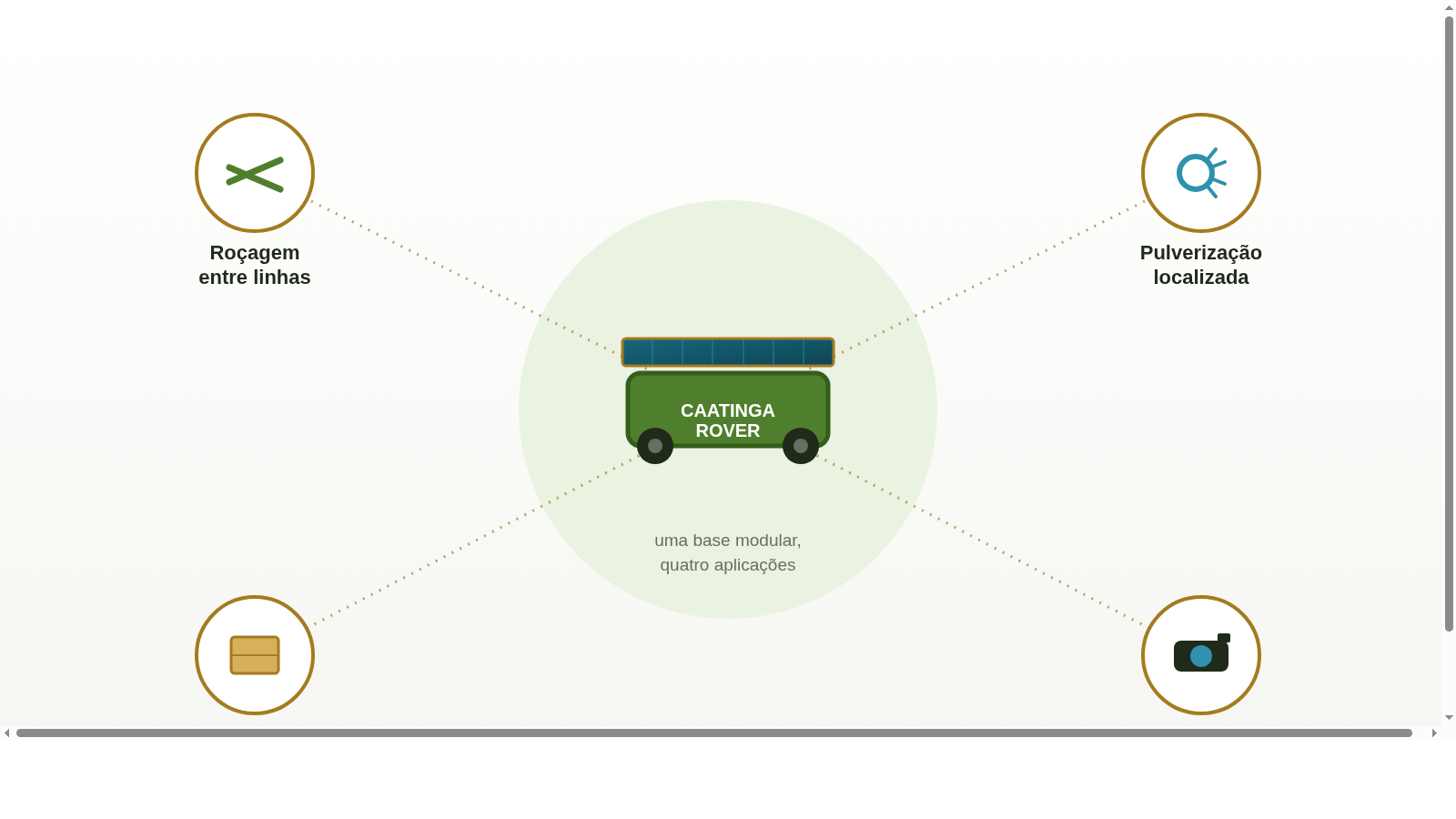
A Caatinga Robotics develops the Caatinga Rover, a 4×4, electric, modular agricultural platform designed to support repetitive field tasks. The proposal is not to replace the farmer, but to put a new tool in their hands: a lightweight, versatile, and adaptable machine capable of reducing physical effort, saving time, and expanding the property's operational efficiency.
The central point is modularity: a single robotic base can be prepared for different applications rather than requiring a dedicated machine for each task.
One base, multiple applications
- Row-to-row mowing — vegetation control in crops and between rows, repetitive task and today predominantly manual.
- Localized spraying — targeted application, reducing input waste compared to application over the whole area.
- Ingress of inputs — light-load transport within the property, saving manual trips.
- LH monitoring — sensors and cameras scanning the area to support management decisions.
This modular design also opens space for new usage models — including by cooperatives, associations and producer groups which can share the same technology in collective mechanization projects, instead of each property needing to purchase its own equipment. More on how we have built these relationships is in Customers and Partners.
Precision agriculture also for small properties
By integrating sensors, cameras, and monitoring systems, the same platform can contribute to more precise agriculture—helping the farmer make better decisions about management, crop health, inputs use, and productivity. Historically, precision agriculture has been associated with large properties with expensive machinery; the proposal here is to bring part of that benefit to a smaller scale.
Where does credit come in: Pronaf Mais Alimentos
The Plano Safra da Agricultura Familiar 2026/2027, announced by the Ministry of Social Development and Family Agriculture, allocates more than R$ 97 billion to rural credit. Within it, the Pronaf Mais Alimentos focuses on supporting investments that modernize the family farming production structure, including machines and equipment — with reduced rates for smaller machinery.
This means that technologies like the Caatinga Rover could, in principle, be evaluated within rural credit technical projects—always respecting the producer's framework, the valid CAF (Cadastro Nacional da Agricultura Familiar), guidance from technical assistance (ATER), and, finally, the analysis of the responsible financial institution. It is not a financing guarantee: it is an institutional pathway that exists and makes sense to explore.
Institutional situation
Caatinga Rover is in TRL 5 — validation in a relevant environment, not a ready-made commercial product. Caatinga Robotics has not, to date, formalized any rural credit partnership or specific financing line for the Rover. What exists is a thesis: Brazilian agricultural robotics can be born close to the producer, built from real field problems and validated with farmers, cooperatives, associations, ATER technicians, research institutions, and public and private partners.
Our objective is to transform Caatinga Rover into a practical solution for lightweight mechanization for family farming: national, modular, electric, and adapted to the real conditions of the semiarid and other productive regions of Brazil. To this end, we seek partners for pilot projects, operational validation, and proposals for intelligent family-farming mechanization.
Learn more: Agricultural Robot in Brazil: Overview, Current Stage, and Cost · How to test the Caatinga Rover