
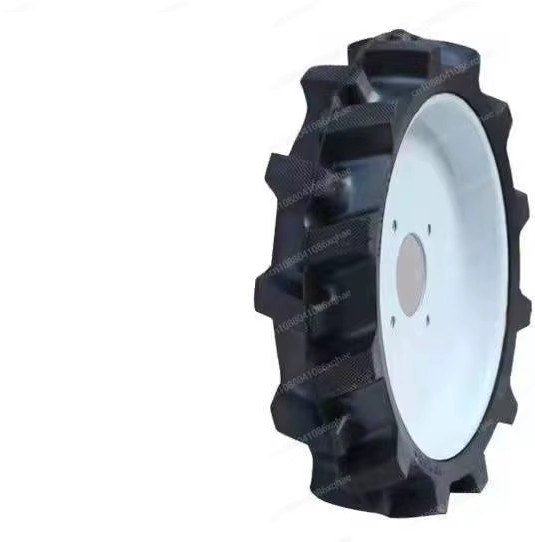
One engineering detail that appears least — but weighs most in daily life of an agricultural robot — is the tire. In Caatinga Rover, the choice fell on the solid tire (tubeless): a solid rubber wheel, non- pneumatic, designed not to puncture on rocky terrains, stumps, thorns and crop residues — a common reality on semiarid properties and in fruit growing and pasture areas in Brazil.

What a solid tire is and why it is different
Unlike conventional tires — which depend on an inner air chamber and can puncture or lose air — the solid tire is made from a single vulcanized rubber block. No air to lose, no tube to replace, and the risk of stopping in the middle of the field due to a puncture simply disappears.
This choice is especially relevant for a autonomous agricultural robot: if the tire punctures far from the operator, there is no one to change it on the spot. Eliminating this failure at the source is safer than trying to detect it later.
Why this matters on the Brazilian agricultural terrain
The semiarid region of the Northeast and much of family farming areas in Brazil share a common challenge: irregular soil, stones, exposed roots, and, in many properties, absence of internal roads prepared for traffic. It is a hostile environment for conventional tires and even more critical for a machine that operates without constant supervision.
- Hole resistance: thorns, stones and pruning debris do not interrupt operation.
- Lower maintenance: without camera, without tire inflation calibration, no tire repair in the middle of the day.
- Traction on uneven terrain: the design of deep treads (visible in the image above) helps maintain grip on loose soil, mud and vegetation cover.
- Predictability: constant contact pressure, without the variation a deflated tire would cause in autonomous navigation.
What is still under validation
Not everything is an advantage without trade-offs. Solid tires tend to be stiffer, which can increase the vibration transmitted to the chassis and require extra attention to suspension and securing electronic components. The Caatinga Rover is in TRL 5, and the behavior of the solid-tire + chassis assembly over multiple seasons and terrains remains part of the test plan described in the Validation and Safety page. We do not claim specific durability, miles-life, or guaranteed savings here — these numbers depend on field trials still in progress.
How this choice fits into the rest of the robot
The solid tire is a component of a larger system. It works together with the autonomous 4x4 traction to maintain stability on climbs and slippery terrain, and with the sensor navigation so that the robot perceives soil variations before compromising the route.
Learn more: Get to know Caatinga Rover · Implements and components · Validation method