
We've already covered which battery type to choose for a battery-powered brush cutter. But there's a part that wears out much faster than the battery, and one almost nobody evaluates before buying: the blade. And the detail most people miss is that its durability depends less on the brush cutter itself and more on what it's actually cutting.
A weed isn't just "weeds" — it has a mechanical profile
From the point of view of anyone designing or maintaining a cutting blade, not all low-lying vegetation behaves the same way. Grasses like signal grass (braquiária), Guinea grass and Bahia grass are fibrous and carry silica within the leaf structure. Woody-stemmed weeds — young shrubs, older clumps — demand more impact force per cut but don't produce the same abrasive effect. Succulent plants or broadleaf weeds with high moisture content wear the edge down very little, but leave sap and residue that accelerate corrosion if the blade isn't cleaned.
In other words: two identical brush cutters, run for the same number of hours, can end the month with blades in completely different condition — simply because they cut different vegetation profiles.
Silica: the abrasive the plant grows on its own
Grasses form microscopic silica structures inside the leaf itself, called phytoliths — part of the plant's natural defense against grazing. From the blade's perspective, cutting this type of vegetation is a bit like repeatedly cutting a surface with fine sand embedded in it. Wear is slow, continuous and cumulative: each pass removes a microscopic layer from the edge, until the cut stops being clean and starts tearing the plant instead.
That's why areas dominated by stiffer-leaved grasses tend to need sharpening more often than areas with mixed or soft-leaved vegetation — even when cutting the same number of hours.
Woody stems: less abrasion, more impact
Young shrubs and clumps with hardened stems put the blade under a different kind of stress: instead of abrasive wear spread across the edge, the impact concentrates force at specific points on the blade with every cut. Repeated thousands of times, that impact can produce micro-cracks, small deformations in the edge, or even chipping — especially on thinner blades or steel with a hardness not suited to that type of vegetation.
In practice, this means a blade that's "sharp but thin" may hold up well in grass and fail too quickly in a shrub-heavy area — and the reverse is just as true.
What this changes about blade choice and maintenance
Understanding the dominant vegetation profile of an area helps decide three things: blade material and hardness (harder alloy steel resists woody-stem impact better; more specific heat treatment resists silica abrasion better), sharpening frequency (more frequent in abrasive-grass areas), and cleaning frequency (more critical in succulent-vegetation areas, because of residual sap). Treating maintenance as a fixed number of hours, without accounting for what's actually being cut, tends to cause blade replacement too early in some cases and poor-quality cuts too late in others.
The Caatinga Rover's mower — and what's still being validated
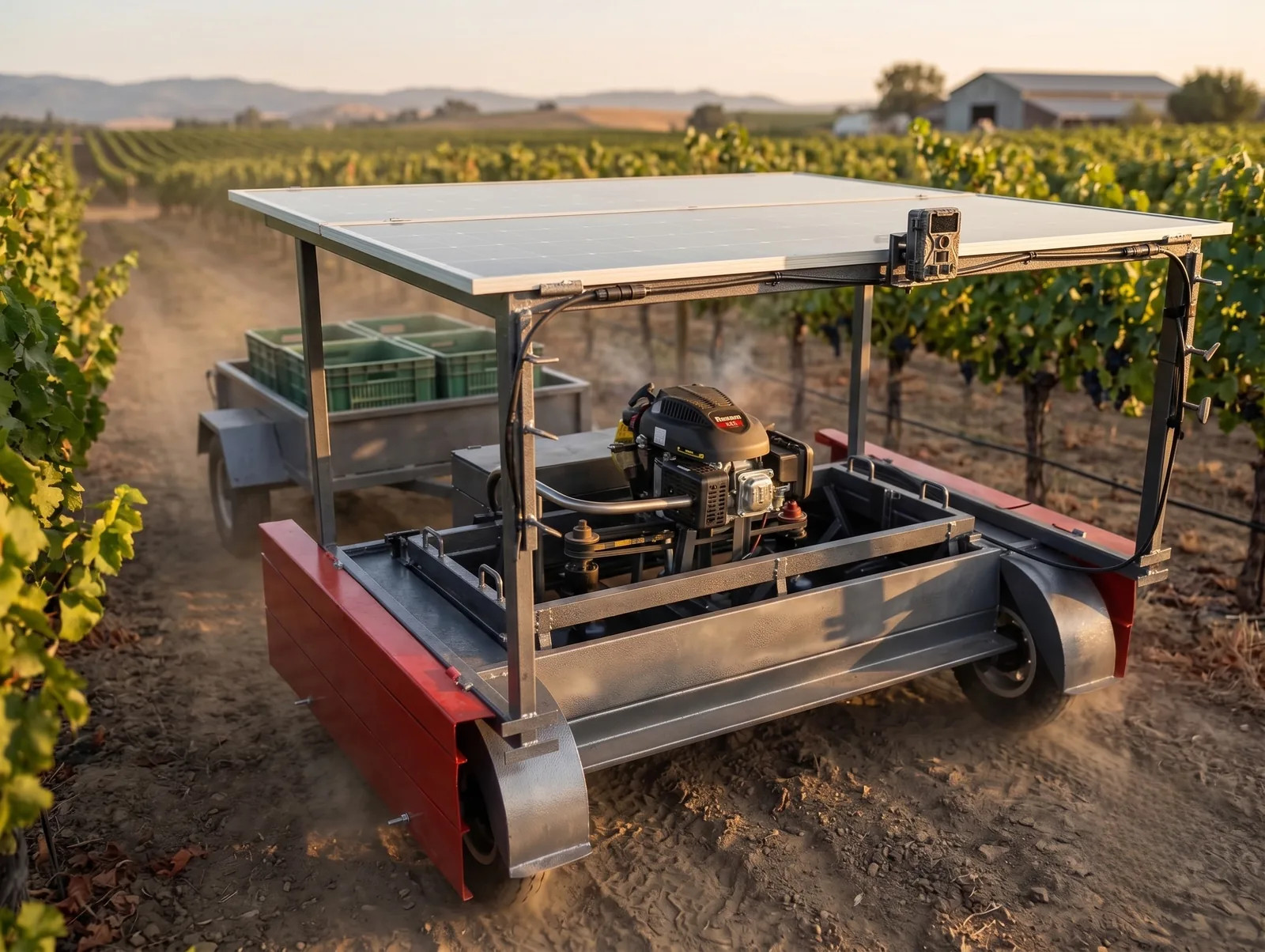
The mower attachment on the Caatinga Rover operates with a 1.25 m cutting width and adjustable height, designed for between-row vegetation management. Blade material, sharpening interval, and how that interval relates to the dominant vegetation profile in each area are still being tested and haven't been publicly documented yet — part of the field-validation work that defines the prototype's current stage.
Institutional situation
Caatinga Rover is at TRL 5 — validation in a relevant environment, not a ready-made commercial product. Blade material specifications, durability, and maintenance intervals remain under test and will be published transparently as they're consolidated.
Learn more: Battery-Powered Brush Cutter: Which Battery Type to Choose? · Caatinga Rover Implements