
Switching from a gas-powered brush cutter to an electric one is usually worth it — less maintenance, no exhaust fumes, a quieter workday. But there's a question most people only ask after deciding to make the switch: which battery, exactly? Because "battery-powered brush cutter" isn't a single technology — and the difference between the cells behind the equipment matters more for your wallet, long-term, than the price tag.
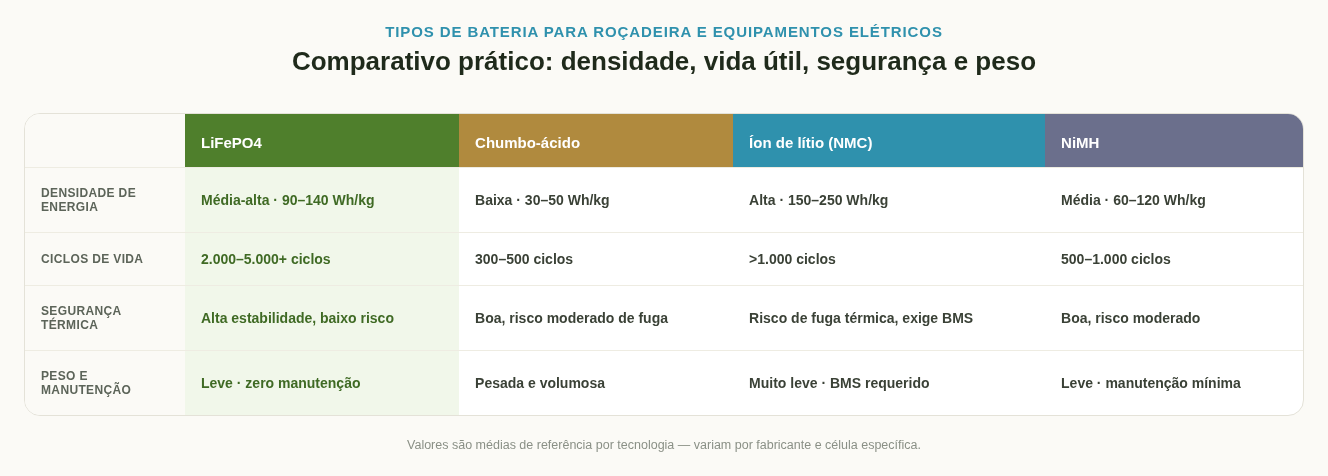
The 4 most common battery types in field electric equipment
Lead-acid is the cheapest and oldest — the same family used in car batteries and UPS systems. Heavy, bulky, and short-lived: between 300 and 500 charge cycles before losing capacity.
Conventional lithium-ion (NMC) is what powers most phones and electric cars. High energy density — meaning more range for the same weight — but with a real risk of thermal runaway if the cell is damaged or poorly managed, which calls for a more rigorous battery management system (BMS).
LiFePO4 (lithium iron phosphate) trades a bit of energy density for much higher thermal stability, a lifespan of 2,000 to 5,000+ cycles, and virtually zero maintenance.
NiMH (nickel-metal hydride) sits in the middle on almost everything — more common today in rechargeable portable tools than in larger equipment.
Cycle life: the number that decides the real cost
A lead-acid battery costs less upfront but lasts 300 to 500 cycles. A LiFePO4 battery costs more at first but handles 2,000 to 5,000+ cycles — 4 to more than 10 times more recharges before needing replacement. Do the math per cycle, not just per purchase price, and the equation shifts heavily in favor of the battery that looked more expensive to begin with.
Thermal safety: a deciding factor in Brazil's semi-arid region
Batteries and heat don't mix well — and that matters especially where equipment operates under direct sun, in already-high ambient temperatures, for hours at a time. Conventional lithium-ion has better energy density, but it's the technology with the highest risk of thermal runaway in case of damage or overheating. LiFePO4 is chemically more stable under these conditions, reducing the risk of catastrophic failure in exactly the most demanding scenario: open field, heat, and continuous use.
The battery Caatinga Rover uses — and why
The Caatinga Rover uses exactly the technology that comes out ahead in this comparison: LiFePO4 cells, paired with an integrated solar panel and a battery management system (BMS) that monitors charge and temperature in real time. The choice wasn't random: thermal stability in semi-arid heat, tolerance for partial recharge (essential for anyone charging with solar power, which doesn't always fill the pack completely), and a lifespan long enough to justify the investment in a platform built to work every day.
The same logic applies to the mower attachment on the Rover: the right battery isn't the cheapest one to buy — it's the one that keeps the operation running for years without becoming a maintenance headache.
Institutional situation
Caatinga Rover is at TRL 5 — validation in a relevant environment, not a ready-made commercial product. Real energy autonomy figures are still evolving across prototypes, published with transparency.
Learn more: Blade Durability vs. Weed Type · Caatinga Rover Implements · Customers and Partners