
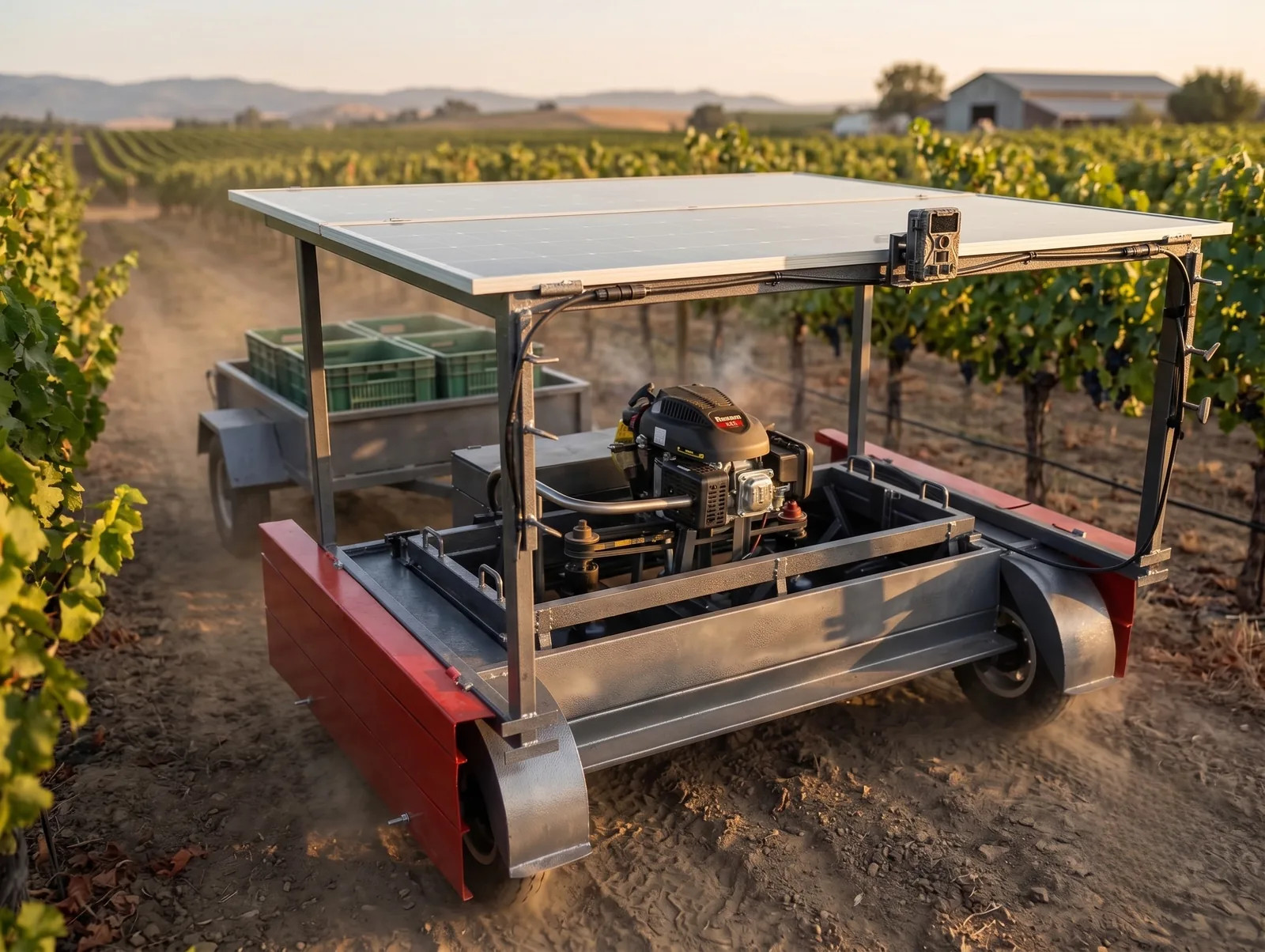
An automatic trimmer spool solves one practical part of brush-cutter work: feeding nylon line with less manual adjustment. But in real field mowing, the recurring problem is rarely one component alone. Stopping to check the line, adjust the head, inspect obstacles and restart the pass can turn into a chain of small interruptions that consumes time and attention.
In the development of the Caatinga Rover, this issue appears as a broader engineering question: how can repetitive mowing be supported by a robotic agricultural base without presenting the tool as a finished or universal solution? The mower implement is under validation and is part of Caatinga Robotics’ work on modular agricultural implements.
How an automatic trimmer spool works
An automatic trimmer spool stores the nylon line used to cut vegetation. As the line wears down, the mechanism releases a new length of line so mowing can continue without opening the head for every adjustment. In conventional brush cutters, this feature improves practicality, but the operator still needs to watch line wear, feeding, fitting and field safety.
In other words, the spool makes line feeding easier, but it does not automate the whole operation. The operator still walks, guides the machine, observes the terrain and decides when to stop. For repetitive field tasks, the question becomes less “which spool should I buy?” and more “how can mowing be organized to reduce interruptions and human effort?”.
What changes when mowing becomes part of a robotic platform?
The Caatinga Rover is being developed as a 4x4 robotic base designed to receive implements, execute repetitive paths and support field tasks under human supervision. For mowing, the technical goal is to evaluate longer and more organized work cycles, assisted operation, test records and adjustments according to vegetation, terrain and row spacing.
This does not eliminate nylon-line wear and it does not remove maintenance. Nylon line remains a consumable. The difference is the system view: instead of looking only at the automatic trimmer spool, the project evaluates movement, implement behavior, onboard energy, safety, operating speed, vegetation density and the need for intervention.
Advantages and limits of an automatic nylon spool
An automatic nylon spool can improve usability because it makes line feeding more practical. It is useful when wear is frequent and the operator needs to keep the brush cutter working. Still, actual continuity depends on more than the spool.
- vegetation density and height;
- stones, fences, posts or debris in the work area;
- quality and thickness of the nylon line;
- travel speed during mowing;
- terrain regularity and slope;
- row spacing and proximity to cultivated plants;
- inspection routine and preventive maintenance.
That is why mowing solutions should be compared as operating systems, not just as accessories. The spool helps, but work organization, safety and compatibility with the field remain decisive.
Which brush cutters are compatible with automatic spools?
Compatibility depends on thread type, fitting diameter, rotation direction, motor power, head design, line thickness and the manufacturer’s recommendation. An incompatible spool may feed poorly, vibrate, wear faster or create operational risk.
With the Caatinga Rover, the logic is different from buying a loose accessory. The mower implement is evaluated as part of the platform. Before any field application, the team needs to observe vegetation type, terrain, work area, row spacing and the expected intensity of the operation. This technical assessment helps avoid decisions made without field context.
Replacing nylon line in conventional systems
In a conventional brush cutter, replacing nylon line usually means turning the equipment off, opening the head, removing worn line, winding new line and reinstalling the set correctly. Even with an automatic spool, line feeding must remain clean, unblocked and within the recommended size.
In a robotic platform, the engineering target is to make inspections easier and reduce unnecessary stops, but maintenance frequency will still depend on the operation. Abrasive vegetation, obstacles, uneven soil and long work cycles accelerate wear. Field validation therefore needs to record not only whether the cut happened, but also how many interventions were needed to keep the task running.
Automatic spool or conventional head?
A conventional head usually requires more direct manual adjustment. An automatic spool makes line feeding more practical, but it remains only one part of the operation. A mower implement integrated with the Caatinga Rover asks a larger question: how can repetitive mowing cycles be assisted by a robotic platform while preserving supervision, safety and validation criteria?
| Solution | Main characteristic | Point of attention |
|---|---|---|
| Conventional head | Mostly manual line replacement and adjustment | Higher dependence on direct intervention |
| Automatic trimmer spool | Makes nylon-line feeding more practical | Does not automate travel or supervision |
| Caatinga Rover with mower implement | Connects mowing to a multi-implement robotic platform | Prototype under validation, dependent on scenario-based testing |
How this connects to Caatinga Rover implements
The mower is one of the Caatinga Rover implements under validation, alongside the sprayer. Other modules, such as transport, quick coupling, sensing and a robotic arm, remain under development. This modularity allows different field tasks to be investigated without presenting the platform as a ready commercial offer.
To understand this architecture, see the Caatinga Rover implements page. To understand the current stage of the robotic base, visit Caatinga Rover: robotic base, functions and navigation. To follow the test criteria, read about validation and safety.
Frequently asked questions
Does the Caatinga Rover eliminate nylon-line replacement?
No. Nylon line is a wear component and will need replacement according to vegetation, terrain, obstacles and operating time. The goal is to evaluate more organized mowing cycles and reduce recurring interruptions, not eliminate maintenance.
Can line changes become less frequent?
In some scenarios, intervals may become longer, but that must be validated case by case. Frequency depends on vegetation density, nylon quality, terrain and task intensity.
Can the robot work between crop rows?
The Caatinga Rover is designed for agricultural applications and can be evaluated for row-based operations, respecting spacing, relief, useful width, crop characteristics and safety conditions.
Does the system work on any terrain?
No. Feasibility must consider slope, soil irregularity, stones, obstacles, moisture, passage width and supervision needs.
Can mowing be adapted to my operation?
Yes. The operation can be studied from the area, vegetation type, current routine, work hours, main difficulty and test objective. To discuss a real area, contact the Caatinga Robotics team.
Automating mowing starts with understanding the field
If the automatic trimmer spool keeps appearing as a recurring concern, the real issue may be larger than choosing an accessory. It may be a repetitive task with too many stops and too much labor tied to low-value effort.
Caatinga Robotics is developing the Caatinga Rover to investigate exactly this kind of challenge. Explore the Caatinga Rover, see the implements under validation or request an operation assessment.