
João de Moura Cardoso was one of 20 awarded inventors in the first edition of a national contest dedicated to machines, equipment, and implements adapted to family farming and to traditional communities. The official result identifies João in the Family Farmer category and records his invention under the title “Multifunction Solar Electric Vehicle for Supporting Family Farming (Focus on Spraying & Mowing).
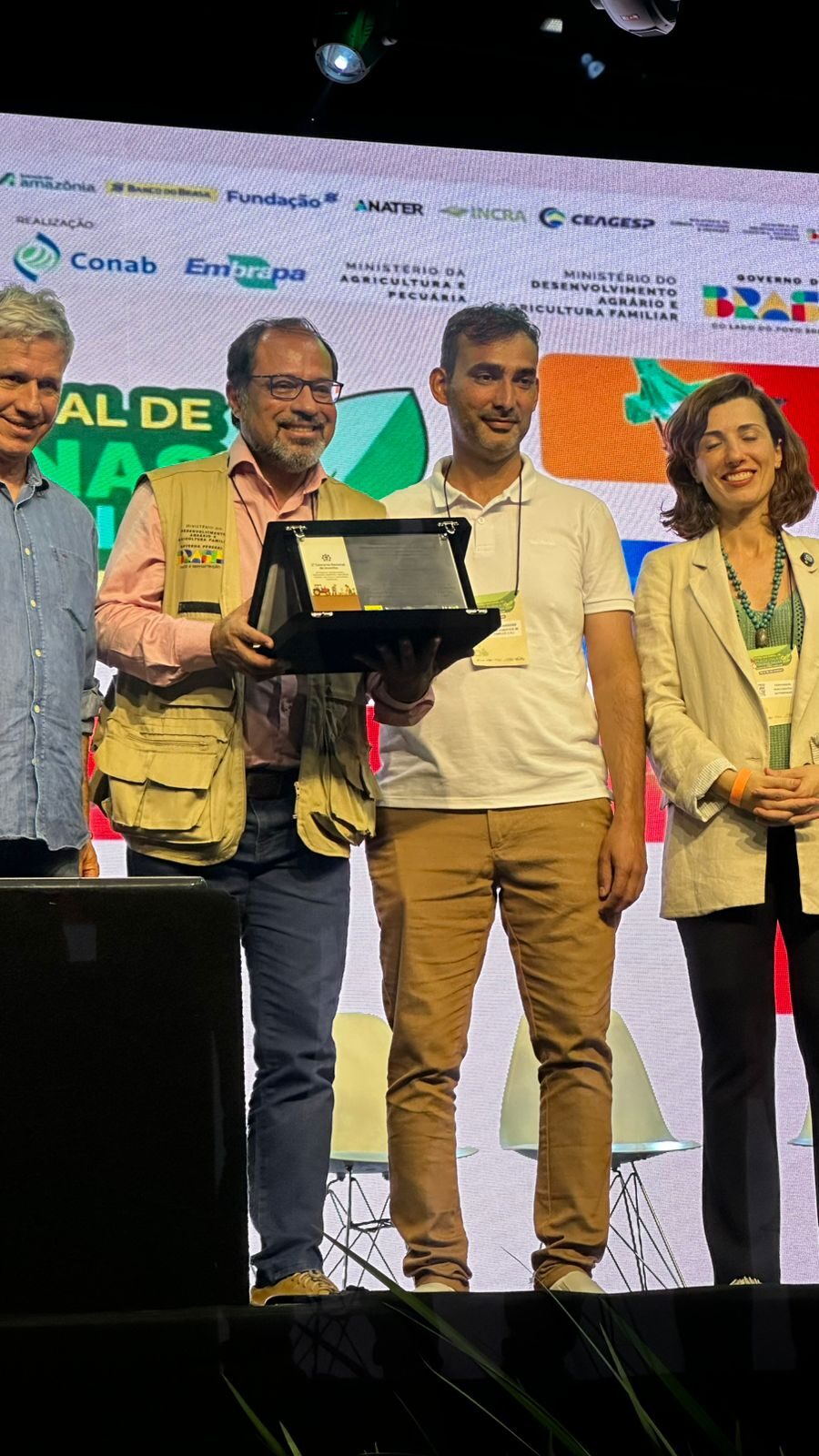
Official recognition
The full name of the initiative is 1st National Contest of Inventions of Machines, Equipment, and Implements Adapted to Family Farming and Traditional Peoples and Communities. According to the official result, the execution involved the Ministry of Agrarian Development and Family Farming (MDA), in partnership with Embrapa and the National Agency for Technical Assistance and Rural Extension (Anater), with support from Fundação Banco do Brasil.
The first edition received 242 registrations: 113 farmers and farmer-owners, 66 researchers, and 63 entrepreneurs of micro and small enterprises. Twenty inventions were awarded in three categories. The official list features ten finalists in the Family Farmer category, five in the Researcher category, and five in the Micro/Small Business Entrepreneur category.
The ceremony took place on March 17, 2026, during the National Fair of Machines and Technologies for Family Farming, held from March 16–18 in Campinas (SP). The result does not determine a ranking among the 20 winners. In João's case, the recognition was granted to the inventor’s authorship of the registered invention—not to Caatinga Robotics as a legal entity.

Consult the final results of the competition — official Embrapa document (PDF)
From recognized invention to Caatinga Rover
The solution registered by João is the origin of the platform that Caatinga Robotics currently presents as Caatinga Rover. The concept combines a mobile electric platform, 4×4 traction, photovoltaic support, and an interface for different agricultural implements. The proposal is to support repetitive and physically demanding tasks, with initial focus on conditions of family farming.
Today, the project is communicated as a prototype under validation. The physical base, mobility, operator control, and the first implements integrate the work already done. Resources such as waypoint autonomous navigation, GPS RTK/IMU localization, obstacle detection, geofencing, advanced telemetry, and expanded agronomic validation remain in development or in testing phases.
This distinction is important: the award recognizes the invention and its relevance to family farming challenges, but it does not constitute certification, homologation, institutional partnership, or proof of commercial performance. It also does not mean that the equipment is available for sale. Consumption, operational capacity, task quality, safety, durability, and costs still need to be measured by defined protocols and under different field conditions.
Caatinga Rover capabilities
Caatinga Rover was conceived as a robotic base capable of receiving different implements and performing repetitive field tasks. At the current stage, the prototype combines electric 4×4 traction, photovoltaic support, operation by analog control and stop with operator intervention. Its modular architecture allows working with implements without requiring a different vehicle for each activity.
Assisted navigation follows the “teach-and-repeat” method: the operator guides the robot on the first pass, while the system records and stores the trajectory; afterwards, the route can be repeated under supervision, with the possibility to interrupt and resume control. This mode should not be confused with full autonomy or independent decision-making.
Among the implements under validation are the mower implement with a cutting width of 1.25 meters and adjustable height and the sprayer designed for crops grown on trellises and canopies. Coverage, flow, uniformity, consumption, safety and durability are still part of the trials.
The development plan includes autonomous navigation by GPS RTK/IMU points, geofencing, speed limits, obstacle detection, telemetry, sensing, and mapping. Transport platform, quick coupling, sensing modules, and robotic arm are also under development.
Why the result is relevant
The competition was created to give visibility to solutions born from concrete problems in rural production. According to the MDA, the selected inventions include equipment adapted for small properties, low-cost implements, material reuse, and technologies focused on sustainability. In this context, João's selection brings the project closer to a national agenda for mechanization that fits family farming reality.
For Caatinga Robotics, recognition expands the responsibility to document technical evolution clearly. The team intends to use upcoming cycles to organize evidence about operation, safety, and performance of the implements, as well as to seek test areas and technical integrations. Institutions cited in future proposals will only be presented as partners when formalization exists.
Next steps
The work remains focused on validating the platform, the 1.25-meter mower implement, and the sprayer designed for crops grown on treillage and hedgerows. Other modules—transport, quick coupling, sensing and robotic arm—are still under development. The navigation evolution will also be addressed step by step: manual control, supervised teach-and-repeat routes, and, later, autonomous missions by waypoints.
Producers, cooperatives, research institutions, and interested organizations can contact us to propose test areas, demonstrations, or technical cooperation. These conversations are for validation and development purposes; they do not constitute reservation, sale, or guaranteed performance.
Official sources
- Official page of the Inventions Contest — Embrapa
- Inventors of family farming are awarded — MDA
- Inventors of family farming are awarded — Embrapa
- Final result and list of the 20 awardees — Embrapa (PDF)
For interviews and information: talk to the Caatinga Robotics team.