
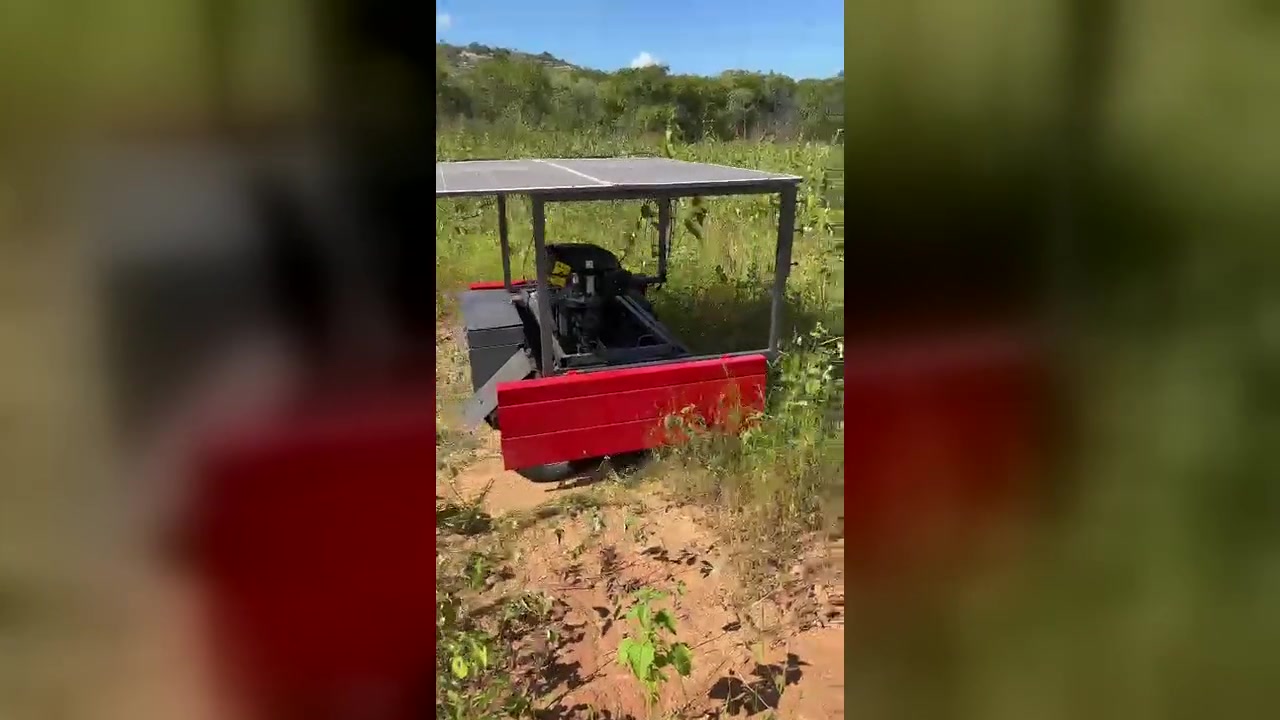
Family farming brings together millions of establishments, grows diverse foods, and sustains the economic life of many municipalities. At the same time, a significant part of daily work still depends on repetitive movements, intense physical effort, and direct contact with dust, heat, and inputs. It is in this concrete scenario — not in an abstract promise of automation — that the Caatinga Rover is being developed.
A broad and very diverse sector
According to the 2017 Agricultural Census, Brazil had 3,897,408 establishments classified as family farming. The same release states that 10.1 million people were employed in these establishments. The data help gauge the sector's relevance, but do not authorize a single solution: crops, terrains, production scales, energy availability, and work routines vary significantly between regions and properties.
Source: IBGE — results of the 2017 Agricultural Census.
Where a compact platform can make sense
In gardens, fruit production, and crops grown under structures such as trellises and espalier systems, the available space can limit the entry of conventional machines. There are also tasks of monitoring, transportation, and application that need to be repeated throughout the production cycle. A compact and modular platform can, in principle, support part of these routines without requiring the entire property to be reorganized around the machine.
This possibility must be treated as a technical hypothesis. To know if the equipment actually meets the producer, it is necessary to measure stability, traction capacity, energy consumption, quality of implement performance, safety, ease of operation and maintenance. It is also necessary to observe how soil, slope, vegetation, heat, and dust interfere with performance.
Starting point of the Caatinga Rover
The Caatinga Rover is currently at TRL 5 prototype stage. The setup already includes a 4×4 electric chassis, photovoltaic support, remote control, and initial implements in field trials. This stage demonstrates functional integration in a relevant environment but does not yet equate to a certified product, mass production, or availability for sale.
The current work seeks to transform field observations into engineering requirements. This includes recording failures, reviewing components, improving interfaces, and defining repeatable test protocols. The prototype's role is precisely to expose questions that a computer-aided design alone could not answer.
What still needs to be validated
They are developing ROS2 navigation, fusion of GPS RTK positioning and IMU, obstacle detection, functional safety, sensing, and agronomic data recording. The implements also need to go through controlled evaluation cycles. Productivity results, input savings, reduced effort, or financial return can only be communicated when there is sufficient data, a defined method, and proper comparison.
Therefore, Caatinga Robotics does not present guaranteed percentages or return timelines for the Caatinga Rover. The priority is to build evidence: what works, under which conditions, with which limits and what maintenance is necessary.
Technology built with those who live in the field
A machine intended for family farming must consider more than laboratory performance. Weight, transport, cleaning, repair, interface language, and availability of parts influence adoption. Testing and evaluation with producers are essential to prevent engineering from solving a different problem than the one found in daily work.
Caatinga Robotics welcomes demonstration proposals, test-area access, and technical cooperation. The goal of this stage is to enhance validation quality and inform future decisions based on evidence, while maintaining a clear distinction between a promising prototype and a proven commercial solution.
Criteria for a responsible decision
A future adoption decision should not be based solely on whether the robot moves or powers an implement. It will be necessary to compare task quality with the current process, record preparation time, interruptions, energy consumption, and need for assistance. Ergonomics, movement between areas, and the ability to perform simple repairs are also part of the outcome.
These indicators must be observed under defined and repeatable conditions. When there are differences between crops or soil types, they should appear in the records rather than be hidden by an overall average. This discipline will help identify where the platform adds value, where it needs to change, and in which situations another solution remains more appropriate.